
Phyllis Shafer – Contact – Double Scoop
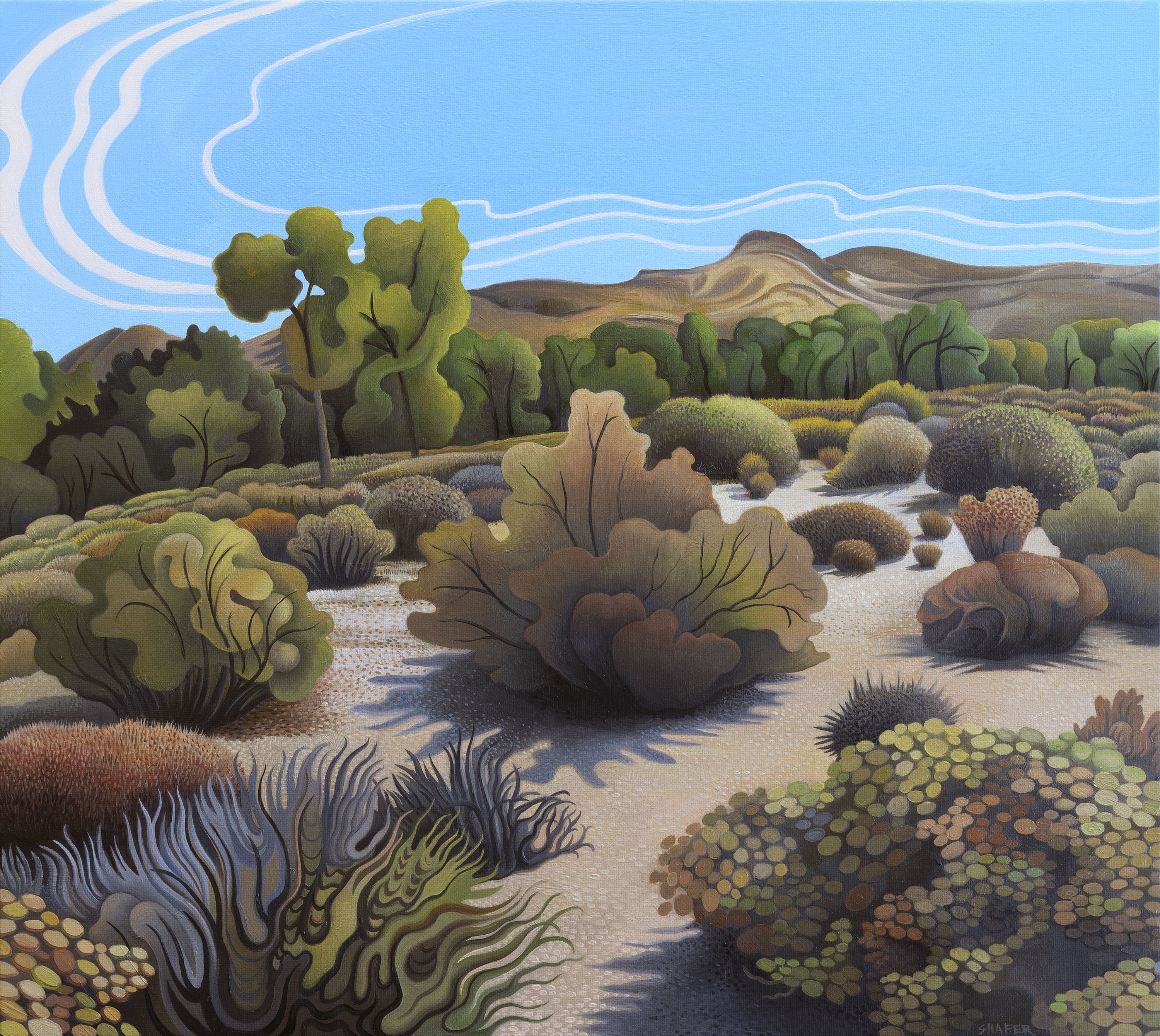
Records of Reverie
– Chris LanierDouble Scoop
It seemed to start like many fundamental journeys in the high desert – they were searching for water. We had met at the parking lot of Fort Churchill State Historic Park, about 20 miles south of Fernley – myself, and the painters Phyllis Shafer and Ahren Hertel. They were working towards a joint show of landscape paintings at the Stremmel Gallery in Reno. I was there to watch, eavesdrop, and ask questions. From the parking lot, we piled into Phyllis’ pickup truck and headed out along a dirt road, scouting for amenable views.
Phyllis drove while Ahren matched the terrain against his phone map, improvising which way to go. They shared an easy camaraderie, talking about their influences, bitching about the vagaries of the art market, comparing notes as educators (Phyllis taught at Lake Tahoe Community College before retiring a few years ago, while Ahren currently teaches at the University of Nevada, Reno, as the area head of painting). Painting in the field is a longstanding element of Phyllis’ practice – for Ahren, who had previously worked up his landscape paintings from his own field photographs, painting outdoors was a new experience. Preparing for the joint show, Ahren and Phyllis have ranged out a few times together. Regarding these excursions, Ahren said to Phyllis, jokingly but sincerely – “I’ve been like, oh, my God, I love this! I’m going to do this every time with you! I’m your new best friend, you can’t get rid of me.”
Just outside the park proper is Bureau of Land Management land. The dirt road follows the edge of the Carson River, in a slightly more tamed echo of its serpentine. The water source, with its bracketing line of cottonwoods, promised some alluring configurations of water, trees, rocks and mountains, but nothing quite clicked at first. They turned off-road into a small gully overhung with trees, the light spattering on the slow-flowing water, but it felt off. You can camp out for 14 consecutive days on BLM land, and this alcove seemed to have been the site of a transient camp. Fragments of trash were threaded through the grass and brush. Some garbage had been collected in a cluster of black trash bags, huddled like enormous, shiny insect eggs laid against a prickly spray of rabbitbrush.
Phyllis mentioned that, accompanied by two men today, she had more freedom in her scouting. Sometimes, alone in the wild, she has brushed up against threatening situations. Once, out in Hope Valley, she was off Blue Lakes Road working on a tondo (a circular artwork), and a man appeared, interposing himself between her and the bush she was painting, announcing that he had just been nude sunbathing. Phyllis responded that the clouds were looking stormy, so it was time for her to pack up. After her canvas and materials had been preemptively stowed, she had her reaction. “I got in the car and this overwhelming anger just bubbled up in me – [this happened] because I’m a woman alone out in nature.” For a time, she had a terrier who would come with her and lie under her easel. Phyllis would drape a towel or cloth from the easel to provide him a box of shade, and he would look out from it, scoping the horizon at her back, and if human figures came into sight, he’d give a simmering growl. “I always felt good with him,” she said.
More recently, she was painting around Tahoe with her earbuds in – “because I get into my groove” – and a man appeared at her shoulder, looking at her canvas. When she finally noticed him, it was as if he’d been clapped out of thin air. “You don’t know if you’re going to do fight or flight,” she said. “Well, I found out I fight. I grabbed a palette knife, and I was like ‘what the fuck!’ He was like, ‘My aunt’s a painter!’”
The three of us ended up circling back to the remains of Fort Churchill. The fort was the first military outpost in Nevada, established in 1860 in the wake of the Pyramid Lake War, which was precipitated by the kidnapping and molestation of two young Paiute girls. According to Sarah Winnemucca’s account in her 1883 memoir Life Among the Paiutes, a party of Paiute riders found the girls bound and gagged in the cellar of Williams Station, a combination stagecoach stop, saloon and store owned by the Williams brothers, about nine miles to the northeast. Upon the girls’ discovery, the two present Williams brothers were killed, along with three other whites, and the station was set afire. An armed mob was mustered from Carson City, making their way towards Pyramid Lake, the home territory of the local Paiute, for revenge. But the impromptu militia was lured to a ravine where an ambush had been laid and they were routed, suffering over 70 casualties.”
A more organized military force was sent to Pyramid Lake in response, and the Paiute were driven out for a time – Fort Churchill was constructed to obstruct their return, and to exert military control over the area. It was active for nine years, and then deserted – in the 1930s, it was taken under the wing of the National Park Service. By then, the desert had had its way with the abandoned buildings, the crumbled walls of the structures making quadrants of empty air. Some of the buildings have only one wall standing, looking like the facades built for Hollywood Westerns – putting up an authoritative front, with the implied habitation behind merely fiction.
Instead of setting up to look at the ruins, Phyllis and Ahren turned toward the river, sunken below the sight line, but sustaining an unbroken ridge of cottonwoods, transpiring its water up into an irregular joined canopy – a shaggy and verdant undulation against the brown slopes of the mountains. As Phyllis and Ahren arranged their easels, I made my remark that it was funny that, here in the desert, these two artists had acted like anyone trying to survive in this place, chasing the green, hunting the water. I asked what the difference was between hunting water for sustenance, and hunting water for aesthetics.
“I hate to say it, but it’s just logistics.” Phyllis said. “I jump in the water when I’m painting and get back out. I leave my clothes on and then you’ve got this automatic air conditioning.” She had in fact, moments before, dipped a kerchief in water and draped it around her neck. It was a pretty blazing day. “Also, because I’m mostly painting in the Sierra mountains, there’s lots of water, and water is a great compositional element to take you through the picture plane.” And that is how painters are like rivers or creeks – making lines in a space.
Human Omissions
One thing that joins Phyllis and Ahren as landscape painters is a pointed exclusion of human-built infrastructures in their paintings. For Ahren, some of the use of broken color across the canvas, which gives his landscape work a spackled energy, is a method of omission, a technique to blank out evidence of human presence. “There could be a break in the canvas where I left out a road, but I didn’t try to make things up, or put something over it,” he said. “I just said, ‘I don’t want to paint that.’ You’re left with the colored ground behind it – it gives a broken quality to the painting. That started developing into a way of approaching laying down paint, and letting space break up a little bit.”
More than a formal attack, it’s also a step back in time, and a way of imbuing the space with a kind of distance, a remoteness, that’s attached to his outdoor experiences living as a kid in South Reno. It was easy, back then, to have access to the wild, on foot or on bike. “When I was younger, South Reno was completely undeveloped, but there are still those moments when you walk out of a grocery store, and the doors open, and you see Mount Rose [in the distance] – you feel that space, and you see how wonderful it is.” Human habitation here still smacks up against big swaths of emptiness. “It feels like, in Nevada, that cities and communities are these little islands. We live on these islands, and then we go out into these open places. You’re going from one island to the other, and you’re traveling through this vast expanse of space. I’ve thought of it in relation to maritime painting – moving through something, taking voyages. That’s my interest in depth and space, and passing through and stopping.”
Phyllis was adamant that you’ll never see a human figure in her paintings. She has welcomed fauna into her landscapes – scrub jays, shrikes, bumblebees, butterflies – but people have been barred from her painterly regard (having taught figure drawing and painting for several years, she’s entirely competent at depicting the human figure, but for her, figure painting is a purely academic exercise). When I asked why she felt so strongly about this, she said “It’s really selfish. I get something from looking at the microcosm [of natural forms], that relationship between things right here at our feet, and things out there” – she gestured, with the paint-smeared tip of her brush, toward the line of cottonwoods and the mountains beyond. “That is my religion. And so to put that building in” – again, she used her brush to point out a small single-story structure at the tree line – “that’s not part of my religion.”
I asked if the uninterrupted landscape gave her access to something that felt more permanent or eternal, and she tacked in the opposite direction: “It’s the ephemeral. Realizing we’re all going to die. Nature points that out to you all the time. There are dead things at my feet” – indicating the brittle and broken stems of brush scattered about. “That’ll be me someday. But other things will carry on. So, for me, it’s a way of making sense out of the progression – from youth to adulthood, to old age, to death – that I’m seeing here.”
Flight from Genre
Another common ethic that joins Phyllis and Ahren is approaching the Western landscape as a subject, and not a genre. The exclusion of human infrastructure is related to that – especially at Fort Churchill, with its direct connection to the colonization of the West – where the myth of landscape overtakes the history and reality of the land, performing its own erasures. I mentioned that, given their disinterest and skepticism towards the “cowboy stuff” that so often appears in paintings of the West, it was very on the nose that they were painting with their backs literally turned to the martial history of the West. The ruins of the fort are the ostensible focal point of the park, but they almost took it as a given between each other that they wouldn’t be painting them.
It should be mentioned that in front of them, the Carson River is no less an element of the story of Westward colonization and Indigenous expropriation. Phyllis and Ahren’s easels were set at a point in the Carson River a few miles before it joins up with a diversion from the Truckee River, steered south by the Derby Dam. That diversion was made to capture water for agricultural irrigation along the Carson River watershed. It also, alongside other dams and diversions, dropped the water level at Pyramid Lake by 80 feet, and obstructed the inflow of the Lahontan cutthroat trout, a major food staple for the Pyramid Lake Paiute. The Carson River was a channel for a radical reconfiguring of the function of the land, and a conduit for cultural dispossession. It now flows into the Lahontan reservoir to the northeast, whose waters cover whatever traces remain of the ruins of Williams Station. If its cellar of abduction and abuse still retains some pockets of negative space, they’ve long been choked with mud and dark water. Lahontan Reservoir is still used for farmland irrigation and is a featured part of the Lahontan Recreation Area – a veil of placid blue has been drawn over the scene.
As Phyllis and Ahren painted, they wondered aloud if their visual clean-up of outdoor spaces amounted to a kind of romanticization or nostalgia. If nostalgia does visit their canvases, it’s not as toxic as the nostalgia of Manifest Destiny that clouds genre paintings of the American West – the weird mixture of massacre and amnesia lying under the shade of the white cowboy hat. But they both have an allergy to nostalgia in even innocuous doses. Ahren, for his part, identifies the shift in his work that pointed him towards landscape painting as a reaction to 9-11. That era of national mendacity and propaganda sharpened his hunger for reality, for a kind of factuality. How do you make your way through the story of a place, to get to the place itself? Both Ahren and Phyllis range outdoors not just because it is a repository of appealing compositions, they’re out there to encounter the “real” – however multivalent that word may be, once you begin to poke at it.
At the same time, they encounter the landscape as artists, not cartographers. They aren’t approaching it as a field of reportage, but one of invention. On a superficial level, this may seem paradoxical: to desire reality so that in capturing it you can bend it, visually, towards your subjective impressions and desires. But that’s only paradoxical if you confuse a glass lens with the human sensorium – the wet network of eye, brain and body. The act of painting from observation isn’t mechanical. As Phyllis put it: “It’s not like a camera. You’re taking in everything around you and synthesizing it.”
Phyllis’ idiosyncratic, immediately identifiable style has a direct connection to American regionalist painters, like Grant Wood and Thomas Hart Benton, who pushed the landscape into an almost cartoonish expressiveness, exaggerating natural forms and stretching perspectives like taffy. When she lived in New York, Phyllis got to see Grant Wood’s painting “Death on the Ridge Road” and it made a huge impression on her. It freezes the moment a truck is cresting a hill, about to collide with a sedan speeding in the opposite direction over the center line, as it passes a slower car. The truck’s tires are canted at an impossible tilt, the hill zooms away into deep space, and two ostensibly parallel telephone poles jut into the air at perpendicular angles to each other. When Phyllis saw that canvas, she said, “it was like heroin.”
A painter’s job isn’t necessarily to replicate the way a place looks, but how it feels – where a painter’s tricks of perspective can recall the vertigoes and the vortices of attention we experience as we range around an environment. For myself, there’s also always a hinge in the process of observational drawing – a threshold where you begin to pay less attention to the thing you’re observing, and more to what’s happening on the paper under your pencil. The object of the drawing cedes some of its authority, and the collection of marks on the page begins to dictate the next mark, the next decision. I asked Phyllis and Ahren about that gearshift.
“Where is that meeting point?” Phyllis began. “For me, it’s outdoors versus indoors. I start the paintings plein air, and this is just gathering information, and making compositional decisions. Then when it’s in the studio, it’s more internal. I would never want to be an alla prima painter [one who completes a painting in one sitting] because I would miss that juiciness that happens in the studio. For me, it’s both perceptual and conceptual – and finding the sweet spot between them. Sometimes if I go too far in one direction or the other, I don’t like the results. If I’m making too much of it up it loses the specificity.” She pointed to a mountain protuberance that looked something like a knobbed knee joint. “I really want that ridge to look like that ridge. When I get into the foreground, that’s where I kind of cut loose and do my more rhythmic interpretations of these various plants.”
Ahren added, “I respond to that too. There’s a point where, once it’s mapped out on the panel or on the canvas, it’s about the relationship between things. And then it can become playful – thinking about abstraction or simplification, or how we perceive things. There’s a balance that I want to find between the illusionistic qualities [of the painting], and things breaking down or falling into patterns.” His eye immediately apprehends that aesthetic force of those compositions and patterns, and the time spent looking and painting is an opportunity to refine one’s awareness of them, to be more analytical about them. Sometimes he paints a landscape that was never literally there – compositing from memory certain elements and textures, to invent a plausible terrain. Viewers can get annoyed when they learn that a scene is fictional – when they see a place, even if they have no intention of hitting the road, they want to feel like they can go there.
Past Plein Air
One thing that distinguishes their work from the plein air or naturalist painters of the past is an awareness of scarcity, of precarity. Phyllis remarked that she’s been painting in the Sierra so long, some of the mountaintops she’d recorded now have cell towers topping them off. Ahren chimed in, “Some of this work is, maybe, trying to find those things that I felt were easier to get to when I was younger. Growing up at the base of Mount Rose, going outside was walking right into nature. And it feels like [today] we have to go further for that. Maybe there is a bit of chasing something, or trying to connect back to something that felt easier – but now it takes more effort.”
“We’re living in a time of diminishing resources, whereas the Hudson River painters, Audubon – they just thought it was going to go on forever,” Phyllis added. “And so maybe that is a factor in how we choose to make these images – knowing that we are in a losing proposition here.”
They’re both acutely aware that the cultural conversation – both in terms of landscape painting in particular, and fine art painting in general – has moved on from their activity out at Fort Churchill. There was a moment when painting was part of a national dialogue, when people looked toward Maynard Dixon, or Grant Wood, or Thomas Hart Benton, to try and situate themselves within a national identity. There was a moment when an ordinary citizen could be expected to know who Georgia O’Keefe was – and to have their own perceptual experience of the natural world altered by her visual invention. That moment belongs to another century. The landscape those painters used as raw material for their pictorial innovations still exists, despite the erosions of human infrastructure laid over them or cut through them, but they exist in a different world. Both Ahren and Phyllis have the aura, out in the field, with their palettes set under the lip of their canvases, the pigments mixed on hot glass in ruthless sunlight, of people getting away with something. How fortunate they are to be able to do this – to have an impulse and a reason (however self-generated) to do this, at this late date. They are content to be in conversation with each other – and with the land that persists under their feet and before their eyes – sustaining their modest reservoir of gravity, and the record of their reverie.